
Personal Training in London: Comparing 1-on-1 vs Small Group Coaching
- Arete Gyms

- 8 hours ago
- 12 min read
What if the most expensive route to fitness isn't actually the most effective for your specific professional lifestyle? Many busy Londoners assume that private 1-on-1 personal training is the only way to achieve a sustainable body transformation, yet they often struggle with consistency when work stress peaks or gym environments feel overly intimidating. It's a common frustration to invest significant resources only to find your physical progression stalling because the training format doesn't quite align with your daily reality.
You deserve a coaching structure that supports your mental well-being and fits your budget without sacrificing expert guidance. This guide helps you discover the most effective personal training format for your goals by comparing the focused attention of 1-on-1 sessions with the supportive, high-energy environment of small group coaching. We'll explore the cost-to-value ratio of each method and how a no-ego community can lead to improved strength and conditioning. Please note that this information is for educational purposes and is not a substitute for professional medical advice; always consult with a doctor before starting a new exercise programme.
Key Takeaways
Understand how specialised facilities in Aldgate offer a more tailored, no-ego environment than traditional commercial gyms.
Compare 1-on-1 and small group personal training to find the right balance of expert coaching, community spirit, and investment.
Learn why recovery tools like saunas and ice baths are essential for long-term progression whilst managing a demanding career.
Gain a practical framework for choosing a facility that aligns with your specific goals, such as a body transformation.
Recognise that this guide is for informational purposes; always consult a doctor or qualified professional before beginning any new exercise programme.
Table of Contents
The Evolution of Personal Training in East London
Before exploring the different coaching formats available, please be aware that this guide is for informational purposes; always consult a doctor or a qualified medical professional before starting a new exercise regime. Over the last decade, the fitness landscape in Aldgate and the wider East London area has undergone a significant shift. We've seen a move away from the sprawling, impersonal "big box" gyms toward specialised independent facilities that prioritise quality over quantity. For the busy professional working in the City, the traditional one-size-fits-all approach to fitness often fails because it doesn't account for high-stress schedules, irregular hours, or the need for a focused, efficient environment.
Modern personal training has evolved to meet these specific demands. Understanding what a personal trainer does in a contemporary setting involves more than just counting repetitions; it's about creating a sustainable framework for health that integrates into a demanding lifestyle. Today, you generally have three main paths to choose from: independent gym access for those who prefer solo work, traditional 1-on-1 coaching for maximum individual attention, and small group personal training, which combines expert guidance with a supportive community spirit.
The Problem with Commercial Gym Environments
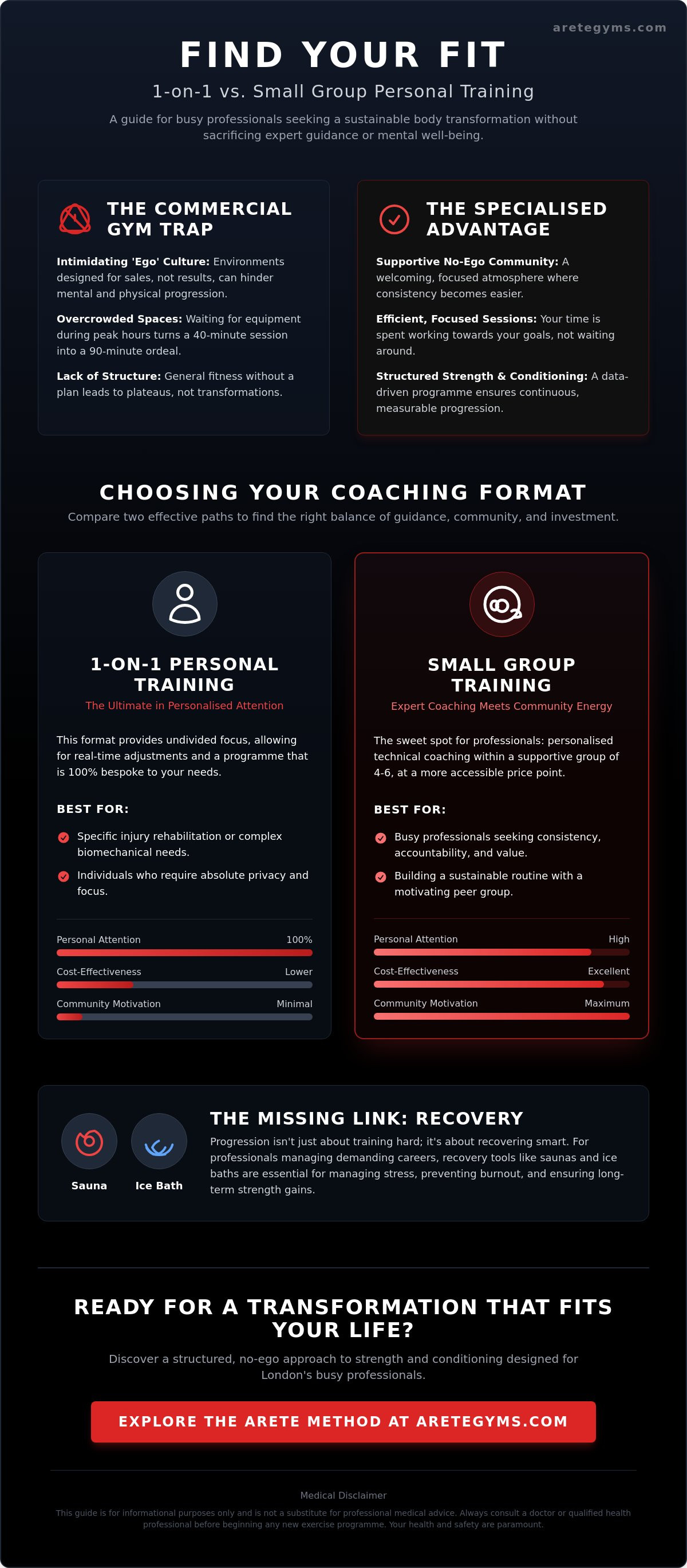
Traditional commercial gyms are often designed around sales targets rather than member results. These spaces can become ego-driven environments that feel intimidating for those who aren't already seasoned athletes. This atmosphere often hinders both physical and mental progression. If you feel uncomfortable in your training space, you're less likely to stay consistent. There's also the practical challenge of equipment availability. During peak London commuting hours, waiting for a squat rack or a bench can turn a forty-minute session into a ninety-minute ordeal. A no-ego philosophy in a specialised facility removes these barriers, ensuring that your time is spent working, not waiting. Consistency becomes easier when the environment is welcoming and organised.
Defining Strength and Conditioning vs. General Fitness
There's a vital distinction between simply "staying active" and following a structured strength and conditioning programme. General fitness often involves repetitive cardio or random exercises that lead to plateaus. In contrast, a personal training programme focused on continuous progression uses data and logic to ensure you're always moving forward. If you want a genuine body transformation, you need a mindset that values movement quality and progressive overload. Professional coaching differs from simply having a workout partner because it provides objective analysis and accountability. It's the difference between just getting tired and actually getting better. Results require structure. Every session should have a purpose that contributes to your long-term wellness and performance.
1-on-1 vs. Small Group Personal Training: A Detailed Comparison
Choosing the right coaching format is a critical step in your fitness journey. Whether you opt for 1-on-1 or small group personal training, the decision should align with your lifestyle, budget, and long-term goals. Whilst 1-on-1 has been the industry standard for decades, the small group model is rapidly becoming the favourite for London professionals who value both expert coaching and a shared sense of purpose. Each format offers distinct advantages, and understanding these differences is key to maintaining consistency amongst the pressures of a busy career.
The Case for 1-on-1 Personal Training
Private sessions offer a level of focus that is difficult to replicate in any other setting. If you are recovering from a specific injury or have highly complex biomechanical needs, having a coach dedicated solely to your movement patterns is invaluable. This format allows for real-time adjustments and a programme that is 100% bespoke to your daily energy levels and physical feedback. However, the higher cost can be a barrier to long-term sustainability for some. Some individuals also find that training in isolation lacks the external spark and healthy competition provided by a peer group.
The Rise of Small Group Personal Training
Small group personal training offers a compelling alternative by providing a "sweet spot" between cost-efficiency and high-level expertise. By training in a group of four to six people, you still receive personalised technical coaching whilst benefiting from a more accessible price point than private sessions. Research highlights various benefits of small group training, including increased motivation and a stronger sense of social support within the gym environment.
This format often results in higher effort levels. When you train alongside others, the collective energy often pushes you to work harder than you might alone. It removes the "ego" often found in commercial gyms, replacing it with a supportive atmosphere where everyone is working toward their own version of a body transformation. Accountability also shifts in a group setting; you aren't just showing up for your coach, but for your community. This social glue makes it much harder to skip sessions when work gets demanding.
Ultimately, your choice depends on your current starting point and psychological preferences. If you require intense corrective work or prefer total privacy, start with 1-on-1. If you are looking for a sustainable, high-performance environment that integrates easily into a professional lifestyle, small group coaching provides the longevity many people need. Please remember that this content is for informational purposes and is not a substitute for professional medical advice; always consult with a doctor before beginning a new exercise programme.
The Missing Link: Why Recovery is Part of Personal Training
Progress is not just a result of what you do on the gym floor; it's a reflection of how well you recover from that work. This information is for educational purposes and is not a substitute for professional medical advice; always consult with a doctor or qualified professional before starting a new exercise or recovery regime. For the busy professional, the "train harder" mantra often leads to burnout rather than results. If your nervous system is constantly under fire from high-pressure meetings and intense personal training sessions, your body may struggle to prioritise muscle growth or fat loss. Effective training requires a balance where restoration is viewed as a performance metric, not an afterthought.
The central nervous system acts as the command centre for your physical output. When this system is overtaxed, your strength levels dip and your risk of injury increases. This is why a dedicated recovery suite is a vital component of any modern fitness facility. By intentionally managing your restoration, you accelerate your return to peak performance, allowing for more consistent and high-quality training sessions throughout the week. Expert guidance in these protocols is essential, as high standards in physiological recovery are just as important as the benchmarks set for ACSM Certified Personal Trainers®.
The Science of Sauna and Ice Baths
Integrating heat and cold exposure into your weekly schedule can significantly reduce inflammation and muscle soreness. This practice, often called contrast therapy, involves moving between the intense heat of a sauna and the sharp cold of an ice bath. Beyond the physical benefits, cold plunges offer a unique mental health advantage for high-stress professionals by triggering a dopamine release and improving focus. You can find a deeper breakdown of these physiological responses in our guide to The Science of Contrast Therapy for Muscle Recovery. These tools are not just for elite athletes; they are pragmatic solutions for anyone looking to maintain a high-performance lifestyle in the City.
Wellness as a Performance Metric
Quality sleep and restoration are just as important for your long-term health as your deadlift personal best. At Arete Gyms, we recognise that a sustainable fitness lifestyle requires more than just sweat; it requires a culture that removes the "ego" from exertion. Our membership structure integrates recovery suite access directly into the experience, ensuring that every session is backed by the tools needed for continuous progression. By moving away from a burnout culture, you create the space for long-term physical and mental well-being. Consistency is born from a body that feels capable, rested, and ready to move forward.
How to Choose the Right Personal Training Facility
Finding the right environment for personal training in London involves more than just checking proximity to your office. It's about finding a space that respects your time and understands the specific pressures of a City career. This content is for informational purposes; always consult a doctor or qualified professional before beginning any new fitness regime. To ensure your investment leads to continuous progression, follow this logical framework for selection:
Define your primary goal: Are you training for a specific event like Hyrox, seeking a total body transformation, or looking to build functional strength?
Evaluate the commute: For consistency, the facility should be easily accessible from Aldgate East or your primary place of work.
Assess the "vibe": Look for a "no-ego" space where the focus is on the work and the community rather than vanity.
Review qualifications: Ensure the team has specialist expertise in strength and conditioning rather than just general fitness.
Check for comprehensive support: A high-quality facility should provide guidance on nutrition, recovery protocols, and structured programming.
Evaluating Coach Expertise
A certificate on the wall is only the starting point. When searching for personal training, you should look for coaches who have a documented history of delivering results for people with similar lifestyles to your own. A dedicated conditioning coach offers significantly more value than a general trainer because they understand how to balance intensity with your body's ability to adapt. This expertise is particularly vital if you're following a Body Transformation for Busy Professionals London programme, where every session must be optimised for efficiency. You need a mentor who can adjust your training based on your sleep, stress levels, and recovery data.
The Importance of Independent Gym Access
Your progress shouldn't be limited to the hours you spend with a coach. A premium facility provides independent gym access, allowing you to follow your programme on your own terms whilst maintaining the same high standards of equipment quality. When evaluating a gym floor, look for the quality of the racks, bars, and conditioning tools rather than the sheer quantity of machines. An independent gym that supports your coached sessions ensures that you can stay consistent even when your schedule doesn't align with a PT slot. If you're ready to see how a specialised environment can support your goals, explore our membership options to find the right fit for your lifestyle.
The Arete Method: Continuous Progression in Aldgate
The Arete Method is built on the core principle of continuous progression. We believe that fitness should be a logical extension of your professional life, providing the strength and mental clarity needed to perform at your peak. To ensure no member plateaus, we organise our training using a methodical approach that prioritises movement quality and data-driven advancement. This guide is for informational purposes and is not a substitute for professional medical advice; always consult with a doctor or qualified professional before starting a new exercise programme. By combining the technical oversight of a specialist coach with the communal drive of a small group, we create an environment where results are inevitable and sustainable.
Our Aldgate East location is designed specifically for the modern professional. We recognise that your time is your most valuable asset, so every element of our facility is optimised for efficiency. This includes the seamless integration of small group personal training with our recovery suite. After a demanding session on the gym floor, members can immediately access our sauna and ice bath to jumpstart the restoration process. This holistic cycle of exertion and recovery ensures you can maintain high-intensity training throughout the week without the risk of burnout or injury.
Taking the first step is often the most difficult part of any transformation. When you arrive for your initial consultation, you won't face a high-pressure sales pitch. Instead, we conduct a pragmatic assessment of your current movement patterns, lifestyle constraints, and long-term ambitions. We use this information to define a clear roadmap for your success, ensuring you're placed in the training format that best supports your goals.
Performance Training for Real Life
Strength training should prepare you for the physical and mental demands of a busy London career. We focus on building a resilient body that can handle high-stress environments whilst still having the energy to enjoy life outside the office. For many of our members, this means moving beyond general gym work to prepare for specific challenges. We provide specialised coaching to help you excel in competitive environments, which is why many people ask, What is Hyrox Training? when looking for a new performance benchmark. Our personal training ensures you have the engine and the strength to compete at your best.
Join the Arete Community
Progress is rarely a solitary struggle. At Arete, you receive the backing of both expert mentors and a community of like-minded professionals who share your dedication to improvement. We prioritise long-term health and functional performance over the "quick fix" culture prevalent in many commercial gyms. This supportive "no-ego" spirit acts as the social glue that keeps you accountable and motivated. If you're ready to experience a more sophisticated approach to fitness, Book a consultation at Arete Gyms Aldgate East today and begin your journey toward continuous progression.
Take the Next Step Toward Sustainable Progression
Finding the right personal training format in London is about more than just a workout; it's about building a lifestyle that supports your professional ambitions and physical potential. We've explored how matching your coaching to your daily schedule and prioritising restoration through a dedicated recovery suite can transform your results. Whether you thrive in the focused environment of 1-on-1 sessions or the supportive energy of a small group, the key is consistency and expert guidance. Please remember that this information is for educational purposes and is not a substitute for professional medical advice; you should always consult with a doctor before beginning a new programme.
As an independent local East London business, we are committed to providing a specialist strength and conditioning facility that removes the ego and focuses on the people. With our recovery suite featuring a sauna and ice bath, you have every tool needed to ensure continuous improvement. You don't have to navigate your fitness journey alone. Start your progression-led journey at Arete Gyms today and experience a more sophisticated approach to wellness. Your potential is waiting; let's move forward together.
Frequently Asked Questions
How much does personal training cost in London?
The average hourly rate for an experienced coach in London typically falls between £60 and £90, whilst specialist or elite trainers can charge over £100 per session. Budget-friendly options at larger gym chains often range from £25 to £60. Small group formats generally provide a more cost-effective alternative by sharing the coach's expertise amongst several members without compromising on the quality of instruction.
Is small group personal training as effective as 1-on-1?
Small group personal training is highly effective for the majority of fitness goals, particularly strength building and body composition. Whilst private sessions offer total isolation, the group dynamic often fosters higher intensity and better consistency through social support. If you don't require specific injury rehabilitation, the collective energy of a small group can actually accelerate your physical progression and mental resilience.
What should I look for in a personal trainer near Aldgate?
Look for a facility that prioritises strength and conditioning over general cardio and offers a "no-ego" atmosphere. It's essential to find a space that understands the professional lifestyle and provides high-quality equipment. You should also check if the coaches hold at least a Level 3 qualification and have a proven track record of helping clients achieve sustainable results within the local community.
How many times a week should I do personal training for a body transformation?
Training two to four times per week is generally the optimal frequency for a successful body transformation. This schedule allows for enough volume to stimulate muscle growth whilst ensuring your nervous system has adequate time to recover between sessions. Consistency is far more important than intensity; it's better to train three times every week than six times for one week and then stopping completely.
Can beginners join small group personal training sessions?
Beginners are absolutely welcome in small group sessions, as the coach organises the movements to suit each individual's starting point. A supportive community environment often helps newcomers feel less intimidated than they might in a traditional commercial gym. You'll receive the same technical guidance on movement patterns whilst benefiting from the backing and encouragement of your fellow members as you learn.
Does personal training include nutritional advice and recovery?
Comprehensive personal training should integrate both nutritional guidance and recovery protocols to ensure long-term success. Progress is heavily influenced by what happens outside the gym, so look for facilities that offer tools like saunas and ice baths to support restoration. Always remember that health-related information is not a substitute for professional medical advice; you should consult a doctor before making significant lifestyle changes.
What is the difference between a personal trainer and a conditioning coach?
A conditioning coach typically focuses on the logic behind each movement, prioritising long-term performance and injury prevention over purely aesthetic goals. Whilst a traditional personal trainer might focus on general fitness, a specialist coach uses structured progression to improve your overall physical capacity. This methodical approach is particularly beneficial for professionals who need their training to enhance their daily performance and mental focus.
How long does a typical body transformation take?
A sustainable body transformation typically takes between twelve and sixteen weeks of consistent effort. Whilst you might see initial changes in energy levels and mood within a fortnight, significant physical shifts require time for the body to adapt and rebuild muscle tissue. We prioritise long-term health over quick fixes, as a slower, more disciplined approach leads to results that you can actually maintain for years.


Comments