
Strength Training for Injury Prevention in London: The 2026 Performance Guide
- Arete Gyms

- 1 hour ago
- 13 min read
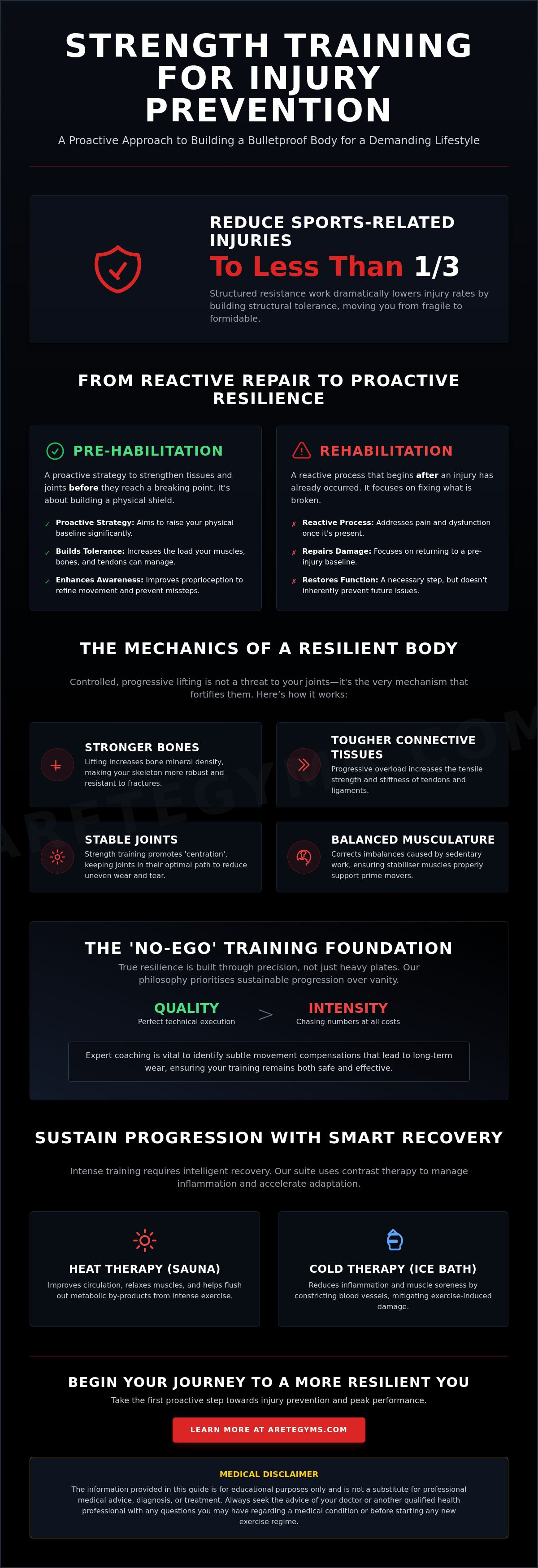
Did you know that incorporating structured resistance work can reduce sports-related injuries to less than one-third of their usual occurrence? For many professionals navigating a high-pressure city lifestyle, persistent lower back niggles or the nagging fear of throwing out your back during a heavy lift often feel like an inevitable tax on your ambition. You likely value consistency, yet minor setbacks continue to stall your physical momentum. This is where expert strength training for injury prevention London becomes your most valuable professional asset, shifting the focus from reactive treatment to proactive resilience.
This 2026 performance guide promises to show you how to move beyond basic stretching to build a truly bulletproof body that thrives under stress. We will explore the specific protocols of progressive loading, the benefits of small group personal training, and how integrating our recovery suite with its sauna and ice bath can ensure your progression remains sustainable. Please note that this information is for educational purposes and is not a substitute for professional medical advice; always consult with a doctor or qualified health professional before starting a new exercise regime.
Key Takeaways
Learn how to transition from reactive treatments to proactive 'pre-habilitation', building the structural tolerance needed to handle a demanding London lifestyle.
Discover how compound movements and progressive loading toughen connective tissues to protect your joints and improve overall stability.
Understand why building physical capacity through strength training for injury prevention London is often more effective for long-term health than simple rest.
Explore the benefits of contrast therapy, using a sauna and ice bath, to manage inflammation and ensure your physical progression remains sustainable.
Adopt a methodical, three-step approach to lifting that prioritises quality over intensity; please consult a doctor as this content is not a substitute for professional medical advice.
Table of Contents
What is Strength Training for Injury Prevention?
Injury prevention isn't merely about avoiding the gym when you feel a twinge. It's better described as 'pre-habilitation', a proactive strategy designed to strengthen your tissues and joints before they reach a breaking point. By engaging in Strength training, you are essentially increasing your structural tolerance. This is the amount of load your muscles, bones, and tendons can manage before they fail. For many, strength training for injury prevention London is about creating a physical buffer against the specific demands of city life. This approach doesn't just make you stronger; it builds a body that's more capable of absorbing the daily stresses of an active lifestyle.
We often refer to the 'London Tax' as the physical toll of a high-pressure career. Long hours spent at a desk or commuting on the Tube create specific vulnerabilities, such as tight hip flexors and weakened glutes. These imbalances often lead to persistent lower back or shoulder issues that can derail your consistency. Identifying these patterns early allows us to address them through targeted movement rather than waiting for a crisis. Please be aware that this content is for informational purposes only; it's not a substitute for professional medical advice, and you should always consult with a doctor before starting a new regime.
The Difference Between Rehab and Pre-hab
Rehabilitation is reactive. It's what happens after an injury occurs to fix what's broken. Pre-habilitation, however, acts as a shield. Whilst rehab focuses on returning to a baseline, pre-hab aims to raise that baseline significantly. Consistent lifting improves bone density and increases tendon stiffness, making your body less susceptible to sudden strains. It also heightens your proprioception, which is your body's ability to sense its position in space. This heightened awareness helps you maintain better form and avoid accidental tweaks during training.
Why 'No-Ego' Training is the Foundation
True resilience is built through precision, not just heavy plates. Chasing numbers at the expense of your form is a fast track to the very injuries you're trying to avoid. A 'no-ego' philosophy ensures that the quality of movement remains the priority. In a supportive gym environment, the focus shifts from vanity to sustainable progression. Expert coaching is vital here. Specialists can identify subtle movement compensations that might lead to long-term wear and tear if left uncorrected, ensuring your strength training for injury prevention London remains both safe and effective.
The Mechanics of Resilience: How Lifting Protects Your Joints
Resilience isn't a fixed trait you're born with; it's a physiological state you can build. Whilst many Londoners worry that heavy lifting might damage their joints, the reality is that controlled loading is exactly what keeps them healthy. By participating in strength training for injury prevention London, you're training your joints to remain 'centrated'. This means they stay in their optimal path during movement, reducing the uneven wear and tear that leads to chronic pain. Always consult a doctor or qualified professional before starting a new exercise regime, as this guide is for informational purposes only.
Progressive overload does more than just inflate your muscles. It increases the tensile strength of your tendons and the density of your ligaments, which are the primary structures holding your joints together. This is particularly important for those with sedentary roles. Long hours at a desk can lead to shoulder impingement or lower back instability because certain muscles become 'sleepy' whilst others overwork. Building structural balance ensures that your smaller stabilising muscles are strong enough to support your larger prime movers. If you're looking to start this journey, our Small Group Personal Training provides the expert oversight needed to master these movements safely.
Adhering to principles for safe and effective strength training ensures that these adaptations happen without crossing into injury territory. It's about finding the 'sweet spot' where the load is heavy enough to cause adaptation but light enough to maintain perfect technical execution.
The Protective Power of Compound Lifts
Compound movements are the gold standard for building global stability. When coached with a no-ego approach, the deadlift is arguably the best tool for 'back-proofing' your body. It teaches the posterior chain to handle significant load, protecting the spine during everyday tasks like lifting a heavy suitcase. Similarly, squats build knee resilience by strengthening the quadriceps and hamstrings, which act as dynamic stabilisers for the joint. For the upper body, overhead pressing encourages scapular stability and shoulder health, provided the movement is performed within your active range of motion.
Load Management: The Science of Not Doing Too Much
In a high-pressure city environment, your total stress load includes your work life, not just your gym time. It's vital to distinguish between 'over-reaching', which is a temporary dip in performance, and 'over-training', which can lead to burnout. We use the Rate of Perceived Exertion (RPE) to help members stay in a safe growth zone. This subjective scale allows you to adjust your intensity based on how you feel on a given day. Adopting this methodical approach also means scheduling regular deload weeks. These periods of reduced intensity allow your nervous system and connective tissues to fully recover, ensuring long-term progression without setbacks.
Strength Training vs. Traditional Physio: A Performance Perspective
Traditional physiotherapy is often the first port of call when pain strikes, and for good reason. Clinical experts are essential for diagnosing acute injuries and managing the initial stages of recovery. However, a gap often exists between being 'pain-free' and being 'resilient'. Whilst a physio might fix the immediate leak, strength and conditioning (S&C) reinforces the entire plumbing system to ensure it doesn't burst again. When you consider strength training for injury prevention London, it's helpful to view the gym as a proactive health centre rather than a reactive clinic. Please note that this information is for educational purposes and is not a substitute for professional medical advice; always consult with a doctor or qualified professional before starting a new exercise regime.
For many chronic niggles, total rest is rarely the solution. In fact, prolonged inactivity can lead to muscle atrophy and decreased joint stability, making you more vulnerable when you eventually return to activity. The S&C approach focuses on building 'capacity'. This means increasing the amount of work your body can handle before it signals pain. By utilising Small Group Personal Training, you gain the 'eyes-on' technical correction usually associated with a clinical setting, but within a framework designed for physical progression and long-term wellness.
Moving Beyond the Resistance Band
Low-level 'rehab' exercises, like those using light resistance bands, are excellent for muscle activation. However, they don't provide the level of mechanical stress required to protect you in the real world. To build a truly resilient body, you must eventually transition from isolated movements to functional, heavy patterns. This doesn't mean jumping straight into maximum loads. It involves a methodical progression where we integrate mobility work directly into your lifting sessions. This ensures you're not just flexible, but strong and stable through your entire range of motion, saving you time whilst maximising your protection.
The Benefits of Specialist Coaching in Aldgate
Local professionals in Aldgate often face unique physical challenges stemming from a desk-bound lifestyle. Sitting for ten hours a day creates specific postural compensations that a generic workout won't fix. Specialist coaches understand these patterns and can tailor your strength training for injury prevention London to counteract the 'desk-worker' hunch. A structured training environment provides the accountability needed to stay consistent, whilst the Small Group PT model balances individual attention with the motivation of a supportive community. This combination ensures that your training is not just a separate hobby, but a necessary tool for maintaining your professional performance.
The Recovery Suite: Using Heat and Cold to Prevent Overuse
Training hard is only one half of the resilience equation. If your body cannot recover from the stress of a heavy session, the risk of overuse injuries increases significantly. Integrating a dedicated recovery protocol alongside your strength training for injury prevention London is the final piece of the resilience puzzle. Contrast therapy, which involves alternating between the sauna and ice bath, serves as a powerful tool for managing systemic inflammation and accelerating the repair of connective tissues. This methodical approach to restoration is becoming increasingly vital; one major gym chain reported a 48% increase in the use of its spa and recovery facilities in 2025 as professionals prioritise longevity over mere exertion. You can learn more about these protocols in The Ultimate Guide to Sauna and Plunge: Maximising Recovery in London 2026.
Please remember that this information is for educational purposes and is not a substitute for professional medical advice; always consult with a doctor or qualified professional before using heat or cold therapy, especially if you have underlying health conditions. To experience these benefits firsthand, you can book our Recovery Suite Access to complement your training programme.
Sauna: Improving Tissue Elasticity and Heart Health
Regular sauna use is about more than just relaxation. The intense heat improves blood flow and nutrient delivery to recovering tissues, which is essential for maintaining joint health. It helps reduce stiffness and improves your active range of motion, making your next lifting session both safer and more effective. Exposure to heat also triggers the release of heat-shock proteins. These specialised molecules play a critical role in muscle preservation and cellular repair, helping to shield your body against the wear and tear of a high-performance lifestyle. For a deeper look at the science, read our guide on Sauna After Workout for Muscle Growth: The London Professional’s Recovery Guide.
Cold Plunge: The 'Reset' Button for the Nervous System
Whilst the sauna expands, the ice bath constricts. This contrast creates a 'vascular pump' that flushes metabolic waste and reduces systemic inflammation. Cold exposure is particularly effective at mitigating Delayed Onset Muscle Soreness (DOMS), allowing you to return to your strength training for injury prevention London with less discomfort. Beyond the physical, the 'cold shock' response acts as a reset button for your central nervous system, building the mental resilience needed to handle high-pressure environments. When using an ice bath after a heavy session, it's best to wait at least four to six hours if your primary goal is hypertrophy, as immediate cold exposure can blunt the initial inflammatory signal required for muscle growth. Safety is paramount; start with short durations of two to three minutes and never plunge alone if you're new to the practice.
Organising Your Injury-Prevention Protocol at Arete Gyms
Transitioning from a reactive approach to a proactive one requires a clear, manageable strategy. At Arete Gyms, we've distilled this into a three-step framework designed specifically for the busy London professional. Our "no-ego" philosophy serves as the primary safety mechanism across all our programmes. It encourages you to focus on your own progression rather than competing with the person next to you. This mindset ensures that your journey towards a body transformation for busy professionals London remains sustainable and injury-free. Please be aware that this content is for informational purposes only; it's not a substitute for professional medical advice, and you should always consult with a doctor before starting a new regime.
Step 1: The Movement Assessment
Your journey begins with a comprehensive movement assessment. During your first session in Aldgate, we'll evaluate your current mobility, stability, and strength levels. We look for 'red flags' such as restricted ankle dorsiflexion or poor thoracic rotation, which are common for those spending long hours at a desk. Identifying these issues early allows us to customise your strength training for injury prevention London, ensuring we build capacity where you need it most. We'll spend the first 12 weeks focusing on performance-based goals, such as mastering the hip hinge or improving overhead stability, rather than just chasing a number on the scale.
Step 2: Consistent Loading and Recovery
Sustainable progress is built on the rhythm of work and rest. We typically recommend a 48-hour recovery window between high-intensity sessions to allow your connective tissues to adapt to the load. Whilst our Small Group PT provides the expert coaching you need, our independent gym access allows you the flexibility to reinforce these movement patterns on your own schedule. We also believe your strength training for injury prevention London is only as effective as your ability to recover from it. We strongly encourage making our recovery facilities in Aldgate a weekly non-negotiable to manage the systemic stress of city life.
Step 3: Joining the Arete Community
The final step is integrating into our supportive community. Training amongst like-minded professionals near Liverpool Street and Aldgate East provides the social backing that prevents burnout and keeps you accountable. When you feel part of a collective effort, the gym stops being a chore and becomes a necessary tool for your professional performance. We offer flexible membership options that cater to the specific time constraints of a demanding career. If you're ready to build a resilient, injury-proof body, book a tour of our Aldgate facility and Recovery Suite today and see how we can support your long-term wellness.
Invest in a Body That Handles the London Pace
Building a body that withstands the pressures of a London career isn't about luck; it's about intentionality. We've explored how progressive loading protects joints and why proactive recovery is the silent partner of physical progress. When you commit to strength training for injury prevention London, you're choosing to move beyond the cycle of reactive therapy and towards a state of continuous, sustainable progression.
At Arete Gyms, our specialist S&C coaches provide the technical oversight needed to lift with confidence. Our no-ego, professional community in East London ensures you have the support to stay consistent, whilst our dedicated recovery suite, featuring a sauna and ice bath, helps you reset after every session. Please note that this information is for educational purposes and isn't a substitute for professional medical advice; always consult with a doctor or qualified professional before starting a new regime.
Start Your Injury-Proof Journey - Join Arete Gyms Aldgate
Your potential for growth is limitless when your body is built to handle the work. We're here to help you move forward with confidence, strength, and a clear path to long-term wellness.
Frequently Asked Questions
Is strength training safe if I already have a minor injury?
Strength training is generally safe and often beneficial for minor injuries, provided the exercises are modified to avoid aggravating the area. Proactive movement helps maintain muscle mass and joint stability during the healing process. However, this content is for informational purposes only. You should always consult a doctor or a qualified medical professional to ensure you're cleared for physical activity before training with any existing injury or niggle.
How often should I do strength training for injury prevention?
Two to three sessions per week is the optimal frequency for most professionals seeking to build long-term resilience. This schedule allows for the necessary 48-hour recovery window between heavy sessions, ensuring your connective tissues have time to adapt and strengthen. Consistency over months is more valuable than high-intensity bursts that lead to burnout, especially when balancing a demanding career in the City.
Can I prevent lower back pain through weightlifting?
Weightlifting is one of the most effective ways to prevent and manage non-specific lower back pain. By strengthening the glutes, hamstrings, and spinal erectors, you create a natural brace that supports your vertebrae during daily tasks. Exercises like the deadlift, when performed with a focus on no-ego form, build the structural tolerance required to counteract the physical toll of a sedentary office lifestyle.
Do I need a personal trainer to avoid getting injured in the gym?
Specialist coaching is highly recommended if you want to maximise safety and ensure your technical execution is flawless. A coach acts as an expert mentor, identifying subtle movement compensations that could lead to setbacks if left unaddressed. Engaging in strength training for injury prevention London with professional oversight provides the eyes-on correction needed to build a bulletproof body without the guesswork.
What are the most common injuries prevented by strength training?
Strength training is particularly effective at preventing muscle strains, ligament sprains, and chronic overuse conditions like tendinopathy. Research published in 2026 indicates that resistance work can reduce sports-related injuries to less than one-third of their usual occurrence. By toughening the tendons and increasing bone density, you create a physical shield that protects your joints during both gym sessions and everyday activities like commuting.
Is an ice bath or sauna better for preventing injuries?
Both tools are effective, but they serve different physiological purposes in your recovery ritual. Cold therapy is best for managing acute inflammation and reducing muscle soreness after intense exertion. Heat therapy, such as a sauna session, is superior for improving blood flow and tissue elasticity. For the best results, we recommend using both in a contrast protocol within a dedicated recovery suite to address different aspects of physical repair.
How long does it take to see the injury-prevention benefits of lifting?
Neuromuscular improvements often begin within the first four weeks, but structural changes in your tendons and ligaments take longer. It typically takes three to six months of consistent loading to see significant increases in tissue density and joint resilience. This is a methodical process of continuous progression rather than a quick fix, requiring a disciplined but approachable attitude towards your long-term wellness.
Will lifting heavy weights make me less flexible or more prone to injury?
Lifting heavy weights will not make you less flexible if you train through a full, active range of motion. In fact, properly programmed strength training for injury prevention London often improves your functional mobility by strengthening muscles in their lengthened positions. You only become more prone to injury if you prioritise ego-lifting over technical quality, which is why we emphasise a no-ego philosophy in all our sessions.


Comments