
Contrast Therapy London: The Professional’s Guide to Sauna and Ice Bath Recovery

What if the most productive part of your working day happened inside a sauna and an ice bath? For many high-performers, the physical toll of intense training often manifests as persistent muscle soreness that interferes with work focus and productivity. You likely understand the frustration of feeling burnt out by a demanding schedule whilst trying to stay physically at your peak. Finding effective contrast therapy London options has become more than a luxury; it's a strategic necessity for those who refuse to let recovery hold them back from their next progression.
In this guide, you'll discover how to master the cycle of heat and cold to accelerate muscle recovery, reduce inflammation, and sharpen your mental clarity. We'll explore how to integrate these methods into a sustainable routine that balances your physical development with a high-pressure career. Please note that this content is not professional medical advice. You should always consult with a doctor or qualified professional before starting contrast therapy. We will examine the specific protocols used by experts to ensure you get the most out of every session, allowing you to move forward with confidence and strength.
Table of Contents
What is Contrast Therapy and Why is it Trending in London?
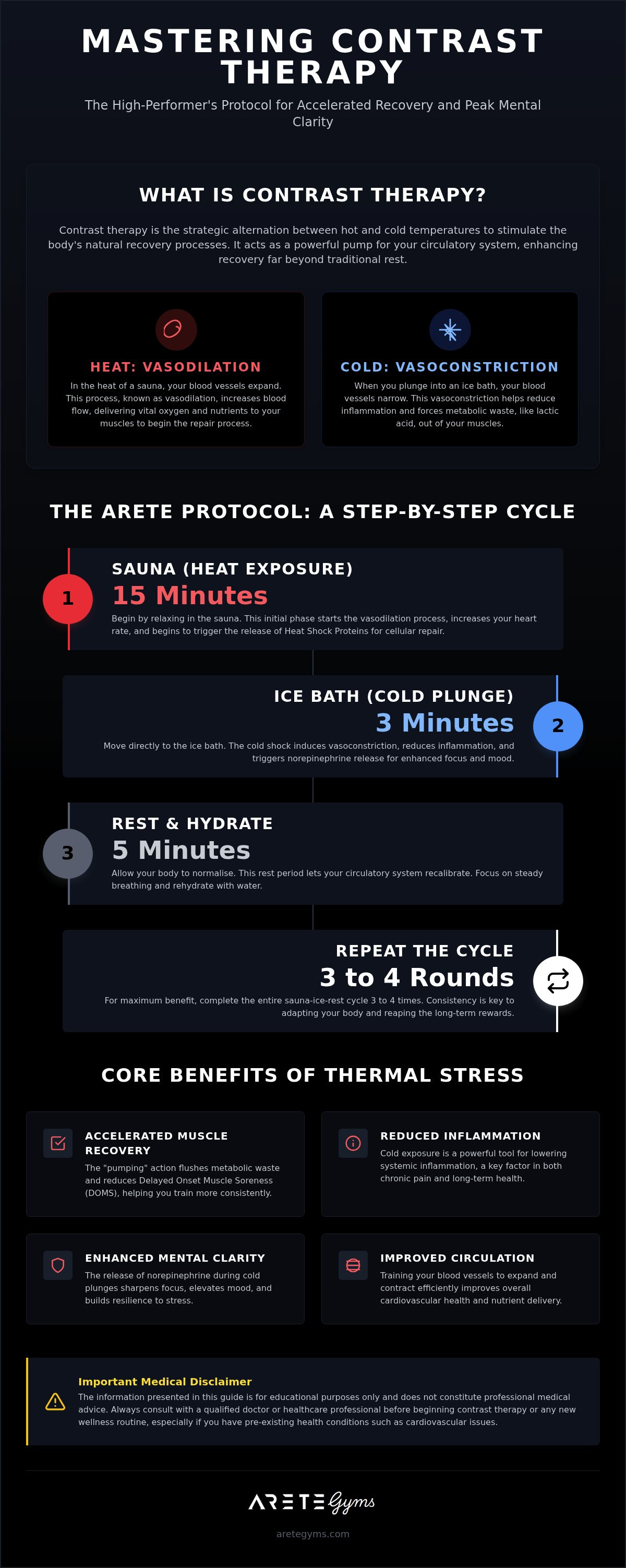
Contrast therapy is the deliberate and strategic alternation between heat and cold environments, typically involving a sauna and an ice bath. If you are looking to understand What is Contrast Therapy, it's essentially a method of "vascular gymnastics." When you enter the heat of a sauna, your blood vessels widen in a process called vasodilation. When you plunge into cold water, they narrow through vasoconstriction. This rhythmic pulsing acts like a pump for your circulatory system, moving blood and nutrients through your tissues with greater efficiency than rest alone.
It is vital to remember that this guide is for educational purposes and is not professional medical advice. You should always consult with a doctor or qualified professional before starting contrast therapy, especially if you have cardiovascular conditions, are pregnant, or have any pre-existing health concerns regarding thermal stress.
In the heart of the City, contrast therapy london has evolved from a niche athlete's secret into a cornerstone of professional wellness. For those balancing high-intensity training with a demanding career, it provides a pragmatic solution to the physical fatigue and mental burnout that often accompany a London lifestyle. By integrating a dedicated sauna and ice bath routine, you can manage the physical toll of your workouts whilst maintaining the mental sharpness required for your professional life.
The History of Heat and Cold Cycles
Whilst these practices have deep Nordic traditions, they've been refined by modern sports science into a precise recovery discipline. Historically, the "sauna and plunge" was a social and health ritual in Northern Europe, but it has now moved from the world of elite athletes to the general public. We've seen a significant shift as specialist recovery centres emerge across East London and the City, making these professional-grade tools accessible to anyone focused on long-term progression. This transition reflects a growing understanding that recovery is not an absence of work, but a vital component of the training cycle itself.
The Physical and Mental Benefits
The advantages of thermal stress go beyond simple relaxation. Physically, the process helps reduce systemic inflammation and eases delayed onset muscle soreness (DOMS). This is achieved through the rapid removal of metabolic waste and the delivery of oxygenated blood to tired muscles. Mentally, the cold shock triggers the release of norepinephrine, a chemical that improves focus and mood. Building this resilience helps you manage high-pressure environments whilst maintaining your training consistency. When you commit to these cycles, you're not just recovering your body; you're fortifying your mind against the stressors of a busy life. If you're looking for more ways to enhance your recovery beyond thermal stress, you can discover SoulfulWaves as an example of how advanced wellness centres are supporting long-term health.
Thermal stress triggers a cascade of biological responses that go far beyond surface-level comfort. When your body is subjected to the high temperatures of a sauna, it produces heat shock proteins (HSPs). These molecules act as a microscopic repair crew, fixing damaged proteins and ensuring your cells continue to function optimally after a strenuous session. Conversely, the cold plunge introduces cold shock proteins, which are instrumental in reducing systemic inflammation and shielding muscle tissue from breakdown. This biological backing is why contrast therapy london has become a staple for those serious about their physical advancement.
According to the American Medical Association on contrast therapy, these physiological shifts require careful management. Please be aware that this information is not professional medical advice; you should always consult with a doctor or qualified professional before engaging in thermal stress practices, especially if you have underlying health conditions.
The true power of this practice lies in the mechanical "pumping" effect on the lymphatic system. Unlike the circulatory system, the lymphatic system lacks a central pump; it relies on muscle contraction and, in this case, the rapid expansion and contraction of vessels to move waste. This process accelerates the clearance of metabolic by-products, leading to significantly faster recovery times. This efficiency often translates into improved sleep quality, as the body's core temperature drops more effectively after a session, which is a vital component for anyone pursuing a body transformation.
Sauna: The Power of Hyperthermic Conditioning
Regular sauna use improves cardiovascular health by increasing plasma volume and reducing the strain on the heart during exercise. Hyperthermic conditioning is the process of improving physical performance and endurance by acclimating the body to heat stress. Deep perspiration during these sessions also supports the body's natural detoxification processes. If you're ready to integrate these tools into your routine, you can explore our expert-led recovery options.
Ice Bath: Mastering the Cold Plunge
Mastering the cold plunge involves more than just enduring the chill. The sudden drop in temperature reduces swelling and provides a natural "numbing" effect on pain receptors, which is particularly helpful for managing delayed onset muscle soreness. Exposure to cold also activates "brown fat," a type of adipose tissue that burns energy to produce heat, potentially boosting your metabolic rate. Success in the water depends on your ability to maintain controlled, steady breathing whilst submerged to manage the initial shock and maintain a calm physiological state.
Contrast Therapy vs. Traditional Recovery: Why Your Body Needs Both
Whilst passive recovery and active recovery have their place, they don't offer the systemic flushing provided by thermal cycles. Passive recovery involves complete rest, whereas active recovery usually entails low-intensity movement like walking. Contrast therapy is different because it proactively manages your physiology. The alternation of heat and cold clears lactic acid and metabolic waste more efficiently than rest alone by forcing blood flow through the tissues. This makes contrast therapy london a vital tool for professionals who need to return to peak performance without the lingering stiffness of delayed onset muscle soreness.
Integrating this proactive approach into a structured Small Group Personal Training programme ensures that your effort on the gym floor is matched by high-quality restoration. It's about creating a holistic loop where training and recovery support one another. When researching contrast therapy london, you'll find that many people focus solely on the physical, but the mental shift is equally important. Moving away from the weights and noise of the main gym floor allows your nervous system to shift from a sympathetic state into a parasympathetic mode, which is essential for managing a high-pressure career.
This content is not professional medical advice; you should always consult with a doctor or qualified professional before starting contrast therapy.
When to Use Contrast Therapy in Your Programme
Timing your sessions depends on your specific goals. If your primary focus is maximum hypertrophy, you might choose to wait 24 to 48 hours after a heavy lifting session before using a cold plunge. This prevents the cold from potentially blunting the initial inflammatory response that signals muscle growth. However, for the majority of professionals, the benefits of reduced systemic inflammation and improved mental clarity often outweigh these concerns. Aiming for one or two sessions per week is usually optimal for maintaining a sustainable long-term wellness routine.
The "No-Ego" Approach to Recovery
Many recovery facilities can feel intimidating, often focusing on how much discomfort you can endure. We believe in a no-ego philosophy that prioritises your long-term progression over short-term "survival." A supportive environment is essential if you're new to ice baths, as it helps you focus on controlled breathing and consistency. Rather than trying to "beat" the cold, you should view it as a tool for restoration. When you approach recovery with this mindset, it becomes a predictable and rewarding part of your lifestyle rather than an added stressor. For those seeking a more immersive restorative experience, the luxury retreats offered by Massoga® Massage Yoga combine Yin yoga and massage to provide a profound way to downregulate the nervous system and enhance physical longevity.
To master contrast therapy london, you need more than just access to the facilities; you need a methodical approach that ensures safety and results. For a busy professional, efficiency is key, and a structured protocol allows you to integrate recovery into your schedule without second-guessing your methods. Before you begin, remember that this content is not professional medical advice. You should always consult with a doctor or qualified professional before starting contrast therapy to ensure it's appropriate for your health profile.
Hydration is the foundation of any successful thermal session. A typical sauna session can result in significant fluid loss through sweat, making it essential to drink water before, during, and after your cycles. Whilst timers are helpful for consistency, you should always prioritise listening to your body's signals. If you experience lightheadedness or excessive shivering, exit the environment immediately regardless of what the clock says. For a deeper dive into the nuances of these sessions, you can read our Sauna and Plunge Guide.
Step-by-Step: The 15-Minute Cycle
A standard cycle involves three distinct phases designed to stress and then restore the body. This repeatable framework helps you build consistency without the ego-driven need to over-exert yourself in the cold:
1. Sauna: Spend 10–15 minutes in the heat (80–90°C) to induce deep perspiration and increase your heart rate.
2. Ice Bath: Submerge for 1–3 minutes in water kept between 5–10°C. Focus on calm, nasal breathing to manage the initial cold shock response.
3. Rest: Spend 2–5 minutes resting at ambient temperature. This allows your heart rate and blood pressure to stabilise before starting the next round.
Advanced Variations for Experienced Users
Once you've built a baseline of resilience, you can increase the intensity by performing 3–4 full rounds. The order in which you finish your session also depends on your specific goals. A "cold-finish" is often preferred during the day to increase alertness and manage inflammation, whilst a "heat-finish" can be more effective in the evening to promote relaxation and deeper sleep. You can safely increase your cold exposure time by adding small increments of 15–30 seconds over several weeks as your physiological tolerance improves. If you're ready to start your progression, you can book your recovery session today.
Accessing Specialist Recovery at Our Aldgate East Facility
Arete Gyms in Aldgate East provides a dedicated environment for those who view recovery as a performance-critical discipline rather than a luxury indulgence. Unlike generic urban spas that focus on a "retreat" experience, our Recovery Suite is designed as the functional counterpart to our Small Group Personal Training and Independent Gym Floor Access. It's a space where the science of thermal stress meets the practical needs of a high-performance lifestyle. If you're searching for contrast therapy london, you'll find our facility conveniently located for professionals working near Liverpool Street, Fenchurch Street, and Aldgate East, making it easy to fit a session into a lunch break or after a long day in the City.
Before visiting, please be mindful that this information is not professional medical advice. You should always consult with a doctor or qualified professional before making decisions about your health or starting a new recovery protocol.
What to Expect in the Arete Recovery Suite
Our suite features a high-quality sauna and a precision-controlled ice bath, ensuring you can follow the Arete protocol with exact temperature management. We've intentionally cultivated a clean, professional, and "no-ego" atmosphere that aligns with our broader gym philosophy. It's an environment where the focus remains on your physical progression and mental restoration rather than vanity or intimidation. Having a dedicated space away from the main training floor allows your nervous system to transition into a state of calm, which is vital for your long-term wellness. The specialist nature of the suite means you aren't just "surviving" the cold; you're using it as a precise tool for improvement within a supportive community.
How to Book Your First Session
Getting started is a straightforward process designed to respect your time. You can visit our Sauna and Ice Bath Booking page to select a time that fits around your professional commitments. We offer various membership options that include recovery access, allowing you to build a consistent routine that supports your training without added friction. If you're looking to master contrast therapy london as part of a dedicated wellness routine, you are taking a significant step toward a more Sustainable Body Transformation. Whether you're finishing a heavy lifting session or simply need to manage the stress of a demanding week, our specialist suite provides the expert-led environment you need to keep moving forward.
Elevate Your Recovery Strategy in the City
Mastering the cycle of heat and cold is a strategic advancement for any professional looking to maintain a high-performance lifestyle. By leveraging the biological mechanisms of thermal stress, you don't just recover faster; you build the mental resilience needed to excel in a demanding career. Our specialist recovery suite in Aldgate East offers a dedicated, no-ego environment where you can apply these evidence-based protocols alongside expert coaching.
Whether you're clearing metabolic waste after a heavy session or seeking mental clarity before a busy week, choosing contrast therapy london ensures your restoration is as intentional as your training. Please remember that this content is not professional medical advice; you should always consult with a doctor or qualified professional before making health-related decisions.
Sustainable progression is about finding the right balance between effort and rest. If you're ready to integrate these professional-grade tools into your routine, the team is here to support your journey every step of the way. Book your sauna and ice bath session at Arete Gyms today and experience the difference that expert-led restoration can make to your well-being. We look forward to welcoming you to the community.
Frequently Asked Questions
Is contrast therapy safe for everyone?
Contrast therapy is not safe for everyone, particularly individuals with cardiovascular conditions, uncontrolled hypertension, or those who are pregnant. This content is not professional medical advice; you must consult a doctor or qualified professional before starting. High thermal stress places significant demand on the heart and circulatory system. At our Aldgate East facility, we prioritise safety and encourage a gradual introduction to ensure your body adapts correctly to the temperature shifts.
How long should I stay in the ice bath for the first time?
Beginners should aim for one to two minutes in the ice bath during their first session. It's more important to focus on calm, nasal breathing than to push for a specific duration. Staying submerged for too long too soon can lead to unnecessary physical stress. As you build resilience within our specialist recovery suite, you can slowly increase this time. Always listen to your body's signals rather than strictly following a timer.
Should I do the sauna or the ice bath first?
Most evidence-based protocols suggest starting with the sauna to raise your core body temperature and induce vasodilation. Entering the heat first prepares your circulatory system for the sudden constriction caused by the cold plunge. This sequence is a standard part of the protocol for contrast therapy london at Arete Gyms. Starting with heat helps relax the muscles and mind, making the transition into the cold water more manageable and effective.
How often should I do contrast therapy to see results?
Performing contrast therapy once or twice a week is typically sufficient for busy professionals to see measurable improvements in recovery and mental clarity. Consistency is more valuable than frequency; integrating these sessions into your weekly routine ensures long-term sustainability. This regularity supports your physical progression between Small Group Personal Training sessions. If your training intensity increases, you might briefly increase the frequency to manage heightened muscle soreness or systemic inflammation.
Will an ice bath stop my muscles from growing?
Cold plunges can potentially blunt the initial inflammatory response required for muscle growth if performed immediately after a heavy hypertrophy session. To avoid this, we recommend waiting 24 to 48 hours after intense strength training before using the ice bath. However, for general recovery, inflammation reduction, and mental health, the benefits often outweigh these concerns. Our expert coaches can help you schedule your recovery suite access to complement your specific body transformation goals.
What should I bring to a contrast therapy session in London?
You should bring appropriate swimwear, a clean towel, and a reusable water bottle to your session. Since the sauna induces deep perspiration, staying hydrated before, during, and after your cycles is vital. We provide a professional and organised environment at our Aldgate East centre, ensuring you have the space needed for a focused recovery. Bringing a change of comfortable clothes for after your session will also help you transition smoothly back into your professional day.
Can I do contrast therapy if I have high blood pressure?
You should not engage in contrast therapy if you have uncontrolled high blood pressure without explicit approval from your physician. The rapid shift between vasodilation in the sauna and vasoconstriction in the cold plunge can cause sudden spikes in blood pressure. This content is not professional medical advice; always consult a doctor before using these facilities. Safety is our primary concern, and we ensure our no-ego environment supports a pragmatic approach to your physical wellness.
How does contrast therapy help with stress and mental health?
Contrast therapy supports mental health by triggering the release of norepinephrine, a chemical that improves focus and mood. The practice also helps regulate the nervous system by encouraging a shift from a "fight or flight" state into a parasympathetic mode. Utilising contrast therapy london provides a dedicated space for mental restoration away from the high-pressure City lifestyle. This mental resilience is just as important as physical recovery for achieving a sustainable long-term wellness routine.


Comments