
Performance Training in East London: 5 Myths Holding You Back in 2026
- Arete Gyms

- May 22
- 13 min read
What if the very thing you think is reserved for elite athletes is actually the missing link in your professional productivity? It's common to feel that a high-pressure career leaves little room for anything beyond a quick, uninspiring treadmill session. You might even worry that performance training east london sounds too intense or carries a high risk of injury in a "hardcore" environment. Most professionals we meet are tired of plateauing with standard commercial gym routines but feel stuck between boredom and the fear of burnout.
We're here to show you that performance training is actually the most efficient tool for the modern professional, focusing on quality movement rather than ego-driven lifting. In this article, you'll discover how to debunk the five most common myths holding you back from your potential and why a specialist community is the key to a sustainable body transformation. We'll explore how shifting your focus toward structured progression can unlock higher energy levels for your work and life.
Please note: This content provides health information for educational purposes and is not a substitute for professional medical advice. Always consult with a doctor or qualified health professional before beginning a new exercise programme.
Key Takeaways
Reframe your approach to fitness by moving beyond generic exercise towards a results-driven method that fits seamlessly into a demanding professional schedule.
Discover why sustainable progression is more effective than "beast mode" intensity for achieving a long-term body transformation without the risk of burnout.
Learn how strength and conditioning creates a lean, athletic physique whilst debunking the common myth that lifting weights makes you "bulky."
Explore how prioritising recovery through sauna and ice bath cycles can help you move forward faster in your performance training east london journey.
Understand how a "no-ego" community provides the accountability to break plateaus, whilst remembering that this guide is not a substitute for professional medical advice.
Table of Contents
Performance Training in East London: Beyond the Professional Athlete Myth
Debunking the "Beast Mode" Fallacy: Why Sustainable Progression Trumps Intensity
Strength and Conditioning vs. Traditional Cardio: Which Delivers Real Results?
Why Recovery is the Overlooked Pillar of Performance in East London
Finding Your Tribe: Why a "No-Ego" Performance Centre is Your Best Asset
Performance Training in East London: Beyond the Professional Athlete Myth
Many people view the gym as a place to simply "burn calories" or "get a sweat on." However, performance training east london is fundamentally different because it shifts the focus from mindless exertion to intentional progression. It's the difference between exercising to feel tired and training to get better. This methodical approach is about training for a specific outcome rather than just moving for the sake of it. Before you begin any new physical programme, please consult with a doctor or qualified professional; this guide is for educational purposes and isn't a substitute for medical advice.
There is a persistent myth that you need a professional sports contract or an Olympic pedigree to step into a performance-based environment. This couldn't be further from the truth. In reality, the principles used by elite athletes to stay resilient and efficient are exactly what busy professionals need to navigate a high-pressure career. It's not about the level you're at currently; it's about the direction you're heading.
What Does "Performance" Actually Mean in 2026?
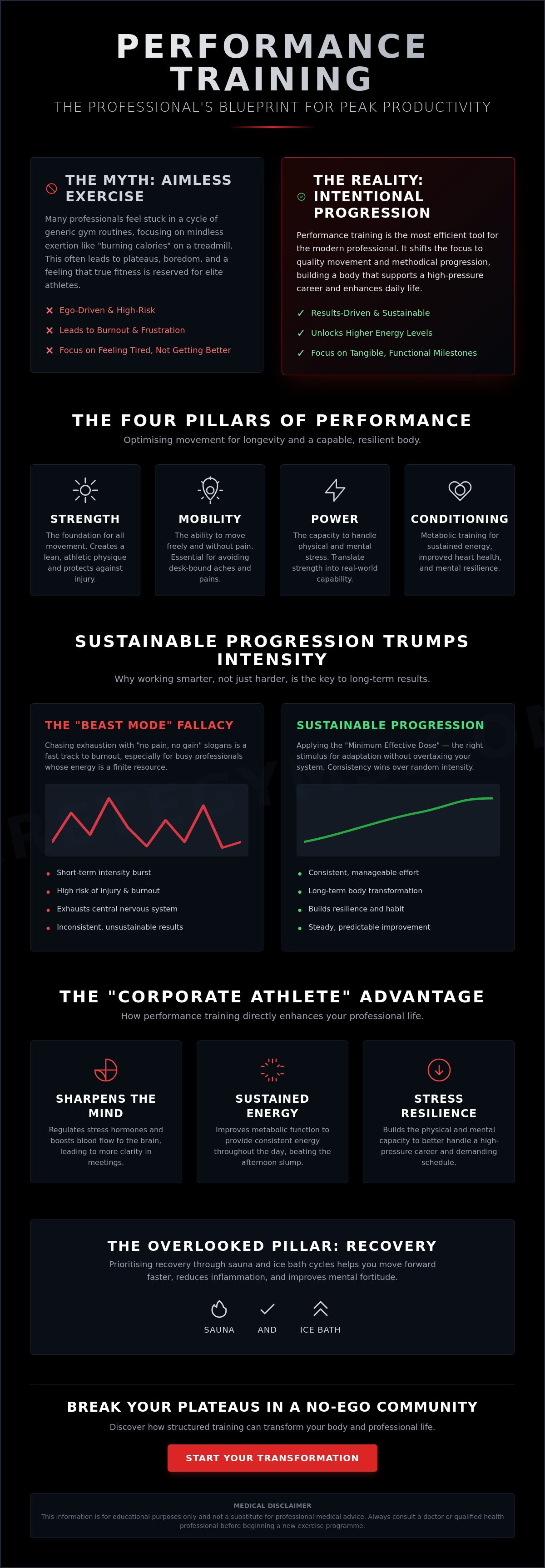
In the modern fitness landscape, we've moved away from purely aesthetic goals. We now look at four key pillars: strength, mobility, power, and metabolic conditioning. Instead of chasing a number on a scale or a specific bicep measurement, you're chasing milestones in how you move, lift, and recover. This transition from vanity-based goals to movement-based milestones ensures that your progress is tangible and functional. Performance is the optimisation of human movement for longevity.
When you focus on these pillars, you develop a body that's capable of more than just looking fit. You build the capacity to handle stress, the mobility to avoid desk-bound aches, and the strength to move through life with ease. It's a holistic shift that prioritises how you feel and function over how you look in a mirror.
Who is Performance Training For?
You don't need to be a pro athlete to benefit from these methods. The "Corporate Athlete" is a very real concept amongst the high-pressure sectors of the city. If you're managing a demanding career, you need your body to support your brain. Unlike the repetitive and often aimless nature of commercial gym cardio, Strength training and performance-based methods provide a structured framework for continuous improvement.
Modern East London centres are designed to be inclusive, no-ego spaces where the focus is on the work, not the image. This environment is particularly beneficial for office-based professionals who face significant cognitive demands. Training for performance sharpens the mind by regulating stress hormones and boosting blood flow to the brain. This leads to improved daily cognitive function, meaning more clarity during meetings and sustained energy throughout the afternoon. It's a pragmatic solution for anyone who values their time and wants their fitness to enhance their professional life.
Debunking the "Beast Mode" Fallacy: Why Sustainable Progression Trumps Intensity
Social media often portrays fitness as a battleground where only the "destroyed" survive. We've all seen the slogans: "no pain, no gain" or "sweat is just fat crying." In the context of performance training east london, we view this approach as a fast track to burnout rather than a path to success. For a busy professional, your energy is a finite resource. If you spend it all in a single, high-intensity session that leaves you unable to function at work the next day, you haven't trained; you've simply exhausted yourself.
We advocate for the "Minimum Effective Dose." This is the precise amount of stimulus required to trigger a physiological adaptation without overtaxing your central nervous system. It's about working smarter. Consistency is far more valuable than a random burst of extreme effort. When you prioritise steady, manageable work, you create a sustainable habit that lasts for years rather than weeks. Expert coaching plays a vital role here, as a specialist can help you manage your training load and ensure you aren't pushing into the "red zone" too frequently. Understanding the importance of rest and recovery is vital for long-term health. Always consult a doctor before starting a new programme to ensure it's appropriate for your individual needs.
The Science of Progressive Overload
Body transformation doesn't happen through radical, one-off changes. It happens through progressive overload. This means making small, incremental increases in weight, repetitions, or technical difficulty over time. These tiny shifts add up to significant results without overwhelming your body. You don't need to feel "destroyed" after every workout to see progress. In fact, if you're constantly pushing to failure, you're likely hindering your ability to recover and grow. Soreness is not a reliable indicator of a productive session.
Avoiding the Injury Trap
The "beast mode" mentality often leads to poor form as people chase numbers at the expense of technique. Proper form acts as a shield against common gym injuries like lower back strains or shoulder impingements. Even in a small group setting, an individualised assessment is crucial. It allows coaches to identify movement patterns that might lead to trouble down the line. We believe that "scaling" or modifying movements is a sign of intelligence, not weakness. It shows a commitment to long-term health over short-term ego. If you're looking for a structured approach that respects your body's limits, exploring small group personal training can provide the oversight needed to manage your load effectively.
Strength and Conditioning vs. Traditional Cardio: Which Delivers Real Results?
How many times have you walked into a gym and headed straight for the treadmill? It's a common behaviour for busy professionals looking to get their workout done as quickly as possible. However, performance training east london provides a significantly higher return on your time investment than steady-state cardio alone. Whilst running on a treadmill burns calories during the session, a structured strength and conditioning programme creates a metabolic shift that lasts long after you've left the gym. This efficiency is vital for those balancing high-pressure careers with personal health goals.
The Truth About Fat Loss and Muscle Tone
There's a persistent myth that lifting weights leads to a bulky appearance. In reality, building lean muscle tissue is the most effective way to create an athletic, toned physique. Muscle is metabolically expensive; the more you have, the higher your resting metabolic rate becomes. This means your body burns more energy even whilst you're sitting in meetings or commuting. It's a pragmatic approach for long-term weight management that beats the "cardio-only" cycle. Please remember that any change to your physical regime should be discussed with a doctor first; this information is for educational purposes and is not a substitute for professional medical advice.
Functional Strength for the Modern World
Performance training isn't just about the numbers on the bar; it's about how you carry yourself in your daily life. For office-based workers, movements like the deadlift, the squat, and the overhead press are incredibly valuable. These exercises build the structural integrity needed to maintain better posture and reduce the chronic back pain often associated with long hours at a desk. There's also a profound psychological benefit to feeling physically capable and strong.
When you know you can move your own body weight with ease, that confidence naturally translates into your professional environment. It's about building a body that's resilient enough to handle the stresses of modern life. By following a structured plan, you can avoid the common trap of Overtraining, ensuring you make steady progress without hitting a plateau or risking injury. This focused approach allows you to achieve better cardiovascular health more efficiently than long-distance cardio, making it the ideal choice for East London's time-poor professionals.
Why Recovery is the Overlooked Pillar of Performance in East London
Many professionals in the city treat their fitness like their careers: they believe that more hours always lead to better results. However, the physiological reality of performance training east london is that you don't actually get stronger whilst you're lifting weights. The gym is where you create the stimulus by breaking down muscle tissue; the actual growth and adaptation happen during your downtime. If you neglect this phase, you aren't just slowing down your progress; you're actively moving toward a plateau. Before making any significant changes to your recovery or exercise habits, always consult a doctor or qualified professional. This guide is for educational purposes and is not a substitute for medical advice.
The myth that "rest days are for the weak" is a dangerous holdover from an era of ego-driven training. In a modern, results-oriented framework, recovery is viewed as an active discipline. It's a strategic tool that allows you to return to your next session with more power and better focus. When you prioritise restoration, you ensure that every minute you spend in the gym is as productive as possible. This is especially vital for East London workers who are already balancing the high cortisol levels of a demanding career with the physical stress of training.
Sauna and Ice Bath: The Science of Restoration
Contrast therapy, which involves cycling between heat and cold, is one of the most effective ways to accelerate muscle repair. Heat exposure in a sauna increases blood flow and helps relax tight tissues, whilst an ice bath triggers a systemic anti-inflammatory response. This cycle helps flush out metabolic waste and reduces the delayed onset muscle soreness that can interfere with your work week. Beyond the physical, deliberate cold exposure offers significant mental health benefits. It builds a unique kind of resilience and "calm under fire" that is incredibly useful for high-stress professionals. To experience these benefits firsthand, you can book into our Recovery Suite Access to support your training programme.
The Role of Nutrition in Performance
Sustainable body transformation requires a shift from restrictive dieting to "fuelling for performance." In a fast-paced environment, it's easy to rely on caffeine and skipped meals, but this approach undermines your hard work in the gym. Prioritising protein synthesis is essential for repairing the tissue you've worked during your sessions. Hydration is equally critical, as even mild dehydration can lead to a significant drop in both physical output and cognitive clarity. Simple hacks, such as preparing high-protein snacks or carrying a dedicated water bottle to meetings, can make a massive difference in how you feel by Friday afternoon. When your nutrition aligns with your movement, your potential for progression becomes limitless.
Finding Your Tribe: Why a "No-Ego" Performance Centre is Your Best Asset
Choosing the right environment is just as important as the training programme itself. In the busy streets of the city, many gyms fall into two categories: the anonymous commercial chain or the intimidating "hardcore" warehouse. A no-ego performance training east london centre offers a third way. It provides a space where high-achieving professionals can focus on their progression without the distraction of vanity or intimidation. This "social glue" transforms the gym from a chore into a supportive community where everyone is working toward their own version of excellence.
Independent gyms often provide a more tailored experience because they aren't bound by the generic corporate mandates of a large chain. You get access to specialist equipment and expert coaching that prioritises your long-term health over short-term fitness trends. It's about finding a place that values your time and understands the constraints of a professional lifestyle. Before starting any new physical regime, it's essential to consult a doctor or qualified professional; this content is for educational purposes and isn't a substitute for medical advice.
The Power of Small Group Personal Training
Small group sessions strike the perfect balance between the individual attention of a 1-to-1 coach and the infectious energy of a group. For a busy professional, accountability is the secret weapon. Knowing that your coach and your peers are expecting you makes it much harder to skip a session after a long day at the office. This structure ensures you're always moving forward safely and effectively whilst benefitting from a lower cost-of-entry than traditional private coaching. If you're ready to start, consider Small Group Personal Training in Aldgate to see how a structured approach can change your results.
Aldgate: The New Hub for Performance Training
Location is a practical pillar of consistency. Integrating your training into your commute or lunch break removes the friction that often leads to missed workouts. Aldgate has emerged as a premier destination for those seeking high-quality facilities that offer more than just a few dumbbells. When you're looking for a local facility, prioritise those that integrate expert coaching, high-end equipment, and dedicated recovery suites. A true performance centre acts as a partner in your professional lifestyle rather than just a place to sweat. It's time to join a community that backs your progression and provides the expert-led environment you need to thrive.
Elevate Your Potential for the Year Ahead
Shifting your perspective from mindless exercise to intentional training is the most effective way to ensure your fitness supports your professional ambitions. By embracing sustainable progression and understanding that recovery is a mandatory discipline, you can avoid the plateaus and burnout that often derail standard gym routines. Choosing performance training east london means moving with purpose, building a resilient body, and reclaiming the energy needed for your high-pressure career.
At Arete Gyms, we provide an independent, no-ego environment in the heart of the city. Our expert-led small group personal training and specialist recovery suite, featuring a sauna and ice bath, are designed to fit seamlessly into your professional workday. If you're ready to move forward with a community that backs your goals, Book Your Performance Consultation at Arete Gyms Aldgate today.
Please consult a doctor or qualified professional before starting any new regime; this information is for educational purposes and is not a substitute for professional medical advice. Your journey toward a more capable, energised self starts with a single intentional choice. We're here to help you make it.
Frequently Asked Questions
Is performance training suitable for beginners?
Yes, it's highly suitable for beginners because it focuses on movement quality and individualised progression. Every movement can be scaled to match your current ability level, ensuring that you build a strong foundation before increasing intensity. This structured approach prevents the common pitfalls of unguided exercise and ensures that your introduction to fitness is both safe and effective. It's about starting where you are and moving forward at a pace that respects your body.
How many times a week should I do performance training to see results?
Most professionals see significant progress by committing to two or three sessions per week. This frequency provides the necessary stimulus to trigger body transformation whilst leaving ample time for recovery and professional responsibilities. Consistency over a long period is far more valuable than a high-intensity burst followed by a long break. Performance training east london is designed to be a sustainable part of your lifestyle rather than a short-term fix.
Will performance training make me look too muscular or "bulky"?
Performance training typically creates a lean, athletic physique rather than a bulky one. Building significant muscle mass requires a specific, high-calorie nutritional strategy and years of dedicated hypertrophy work. For the majority of people, lifting weights results in improved muscle tone and a more defined appearance because muscle tissue is more compact than fat. The goal is to build a body that functions with power and moves with ease.
What is the difference between a commercial gym and a performance centre?
A performance centre focuses on specific outcomes and expert-led coaching rather than just providing rows of machines. Unlike commercial gyms, which often leave you to your own devices, a performance centre prioritises structured progression and community support. You'll find specialist equipment and recovery tools, such as a sauna and ice bath, which are rarely integrated into standard gym environments. It's an intentional space designed for those who value expert guidance.
Do I need to be fit before I start performance training?
You don't need a baseline level of fitness to begin, as the entire purpose of performance training east london is to build that fitness from wherever you are. Coaches assess your current movement patterns and strength levels to create a starting point that is challenging but safe. Waiting to "get fit" before joining is a common mistake; the most efficient way to improve your physical condition is to start with a professional framework today.
How long does a typical performance training session last?
A typical session lasts approximately 60 minutes, which is the ideal duration for a focused and effective workout. This timeframe allows for a thorough warm-up, a dedicated strength or skill block, and a conditioning element without overtaxing your central nervous system. For a busy professional, a 60-minute session is easy to integrate into a lunch break or a commute, providing a high return on a relatively small time investment.
What are the benefits of using a sauna and ice bath after training?
Using a sauna and ice bath, known as contrast therapy, helps to reduce inflammation and accelerate the repair of muscle tissue. The heat from the sauna increases circulation, whilst the cold exposure from an ice bath triggers a systemic recovery response. This combination not only helps with physical wellness but also provides a vital mental "reset," helping to lower cortisol levels after a demanding day in the city.
Can performance training help with lower back pain from sitting at a desk?
Yes, performance training is highly effective at addressing lower back pain by strengthening the posterior chain and improving core stability. Exercises like deadlifts and squats teach you how to stabilise your spine correctly, which translates to better posture when you're at your desk. By building a more resilient body, you can mitigate the negative physical effects of a sedentary office environment and move through your workday without discomfort.
Please note: This content provides health information for educational purposes and is not a substitute for professional medical advice. Always consult with a doctor or qualified professional before beginning a new exercise programme or using recovery facilities like a sauna or ice bath.


Comments