
How to Start Weightlifting for Beginners: The Ultimate Guide for Women in 2026
- Arete Gyms

- 3 days ago
- 13 min read
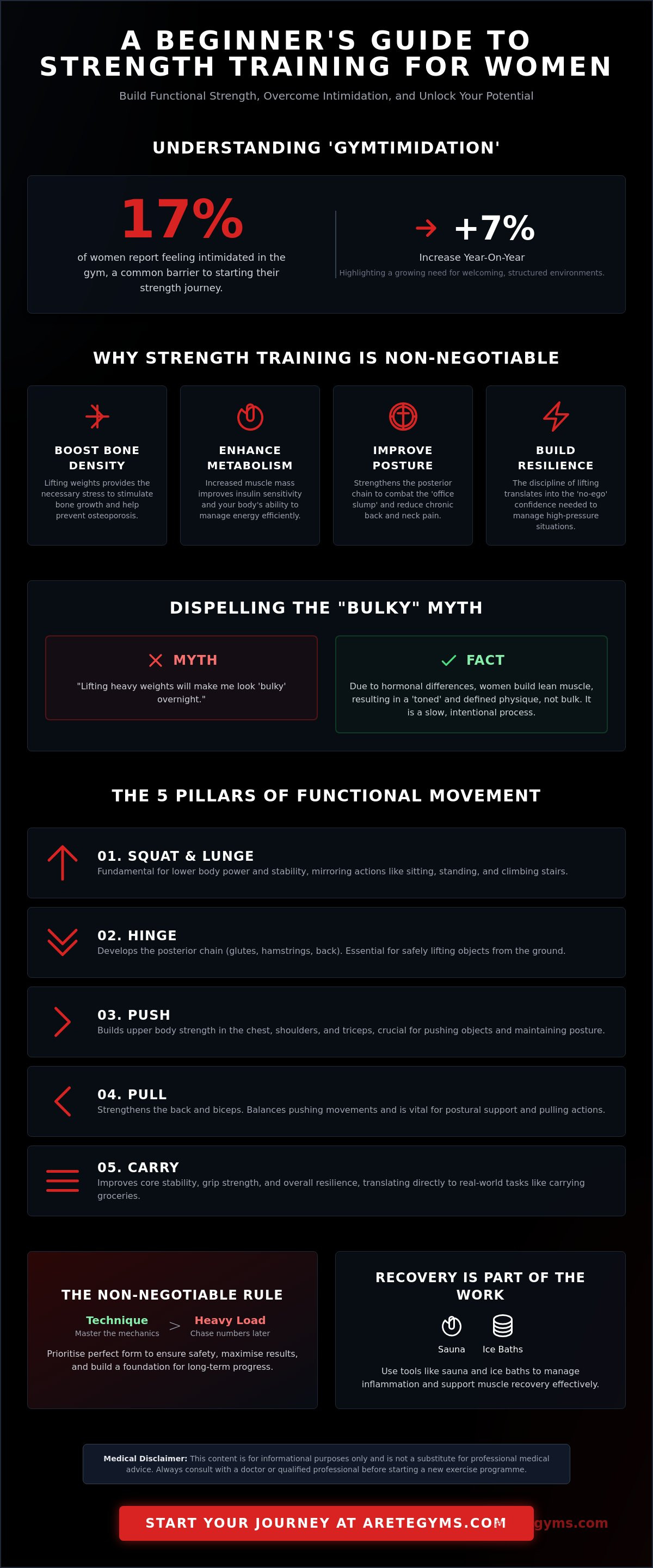
Did you know that 17% of women now report feeling 'gymtimidation', a figure that has risen by 7% year-on-year? It's a common barrier that many high-performing professionals face when they consider stepping onto the weight floor for the first time. You might worry about the "ego" factor or feel unsure about which movements actually deliver results for a busy schedule. If you've felt that hesitation, you're not alone in wanting a more structured, welcoming path. Learning how to start weightlifting for beginners women is about more than just lifting weights; it's about building a foundation for sustainable health and professional performance.
This guide provides a clear roadmap to mastering the fundamentals of strength training with a sophisticated, no-ego approach. You'll learn how to prioritise movements that build functional strength and mental resilience whilst avoiding the fear of "bulking up" unnecessarily. We will cover everything from selecting the right exercises to integrating recovery into your routine, ensuring your fitness supports your career rather than competing with it. Please note that this content is not a substitute for professional medical advice. Always consult with a doctor or qualified professional before starting a new exercise programme.
Key Takeaways
Focus on compound movements that mirror daily activities to build a functional foundation for improved performance and long-term health.
Discover how to start weightlifting for beginners women by prioritising technical form over heavy loads to ensure safety and consistent progress.
Learn why a "no-ego" coaching environment is essential for overcoming gym intimidation and achieving a sustainable body transformation.
Understand that restoration is as vital as exertion, using tools like sauna and ice baths to manage inflammation and support muscle recovery.
Consult with a doctor or qualified professional before beginning any new fitness programme, as this guide is not a substitute for professional medical advice.
Table of Contents
Understanding Strength Training: More Than Just Lifting Weights
Strength training is far more than a simple act of exertion; it's a methodical system of progressive resistance designed to improve the body's ability to generate force. Unlike random exercise, this approach involves a strategic progression where you gradually increase the load, volume, or intensity of your movements. When exploring how to start weightlifting for beginners women, the first step is shifting your mindset from "burning calories" to "building capacity." It's about creating a body that is resilient, capable, and efficient. Please note that this information is not a substitute for professional medical advice, and you should always consult with a doctor or qualified professional before starting a new exercise programme.
For women, resistance training is a non-negotiable tool for long-term health. Official UK guidelines suggest that adults should engage in muscle-strengthening activities at least twice a week to maintain bone mineral density and metabolic health. As we age, our bone density naturally declines; lifting weights provides the necessary stress to stimulate bone growth and prevent osteoporosis. Beyond the skeletal benefits, increased muscle mass improves insulin sensitivity and metabolic rate, making it easier to maintain a healthy body composition whilst supporting your overall longevity.
The Health Benefits for the Modern Woman
If you spend your day behind a desk, you likely experience the "office slump" that leads to chronic back and neck pain. Strength training targets the posterior chain, strengthening the muscles that support your spine and improving your posture naturally. This physical foundation helps balance hormones and reduces the systemic inflammation often caused by high-stress professional environments. By focusing on movement quality, you'll find that your energy levels remain steady throughout the day, providing a natural buffer against the fatigue of a demanding career.
Dispelling Common Weightlifting Myths
The most persistent myth is that lifting heavy weights will lead to an overnight "bulky" appearance. Physiologically, women have significantly lower levels of testosterone than men, making rapid muscle hypertrophy extremely difficult. Building muscle is a slow, intentional process that results in a "toned" or defined look, which is simply the presence of muscle mass with a lower body fat percentage. You don't need to spend hours on a treadmill to see results; in fact, a comprehensive guide to strength training shows that resistance work is often more effective for sustainable body transformation than cardio alone.
Ultimately, the strength you build in the gym translates directly to your professional life. There is a profound link between physical capability and mental resilience. When you learn to navigate a heavy lift with composure, you develop a "no-ego" confidence that helps you manage high-pressure situations at work. Physical strength isn't just about what you can lift; it's about the grit and discipline you cultivate through consistent, methodical progression.
Mastering the Fundamentals: The Five Pillars of Movement
Learning how to start weightlifting for beginners women begins with understanding that your body is designed to move as a single unit. Whilst many commercial gyms steer newcomers toward machines, these isolated movements rarely translate to the functional demands of a professional lifestyle. Instead, we prioritise compound movements. These exercises involve multiple joints and muscle groups working in unison, mimicking real-life actions like lifting a heavy suitcase or climbing stairs. This approach builds the kind of functional stability that machines simply cannot replicate, creating a more resilient body for the long term.
The non-negotiable rule for any beginner is that technical form must always dictate the weight on the bar. It's often tempting to chase higher numbers quickly to match the energy of the gym floor, but your health depends on precision. By mastering the mechanics of a movement first, you create a safe environment for future growth. Once your technique is consistent, you can introduce progressive overload. This is the methodical process of gradually increasing the challenge to your muscles, ensuring that your body continues to adapt, improve, and grow stronger over time.
The Essential Movement Patterns
The Squat and Lunge: These patterns develop lower body power and knee stability. They serve as the foundation for your mobility and overall lower body strength.
The Hinge: Critical for protecting the lower back, the hinge teaches you to engage your glutes and hamstrings. This is vital for counteracting the effects of long hours spent at a desk.
The Push and Pull: Creating balance in the upper body is essential for posture. Pushing movements, such as overhead presses, and pulling movements, like rows, ensure your frame remains symmetrical and strong.
Focusing on Form and Safety
Starting with bodyweight or light dumbbells is the smartest way to build a reliable mind-muscle connection. During every lift, you should focus on core bracing and intentional breathwork to stabilise your spine and manage intra-abdominal pressure. Please be aware that this article provides general information and is not a substitute for professional medical advice. You should always consult with a doctor or qualified professional before starting a new strenuous regime. To ensure you're moving with optimal technique, working with a dedicated personal trainer can provide the expert feedback necessary for safe, confident progression.
Organising your session for maximum efficiency is vital for a busy career. A standard beginner workout should feature one movement from each of the five pillars, performed for two to three sets. This structure provides a total-body stimulus in under 45 minutes, allowing you to integrate training into your day without it feeling like a second job. Consistency in these fundamentals is what eventually leads to the sustainable transformation and mental resilience you're looking for.
Choosing Your Environment: Solo Lifting vs Small Group Coaching
The environment in which you choose to train often determines whether your fitness journey becomes a lifelong habit or a fleeting attempt. For many, the traditional "big box" commercial gym can feel like a vast, anonymous space where the lack of direction leads to frustration. When researching how to start weightlifting for beginners women, the choice usually falls between navigating the gym floor alone or seeking a more structured, specialist facility. Whilst solo training offers flexibility, it often lacks the professional oversight required to ensure your movements are effective and safe. Please note that this guide is for informational purposes and is not a substitute for professional medical advice; you should always consult with a doctor or qualified professional before beginning a new exercise programme.
A "no-ego" philosophy is the cornerstone of a successful training environment. In specialist centres, the focus shifts from vanity and performance theatre to genuine progression and community support. This atmosphere is particularly vital for women who may feel out of place in high-pressure, male-dominated lifting areas. By removing the intimidation factor, you can focus entirely on the "work" and your own personal improvement, rather than worrying about the gaze of others. When you are surrounded by people who prioritise substance over style, your confidence grows alongside your strength.
The Pitfalls of the Independent Gym Floor
Training independently often presents a steep learning curve that is difficult to manage alongside a demanding career. Recent data shows that 17% of women report feeling 'gymtimidation', an increase of 7% year-on-year. This anxiety, combined with a lack of professional guidance, frequently leads to "programme hopping" or plateaus where progress stalls. Without a structured plan and external accountability, busy professionals often find it difficult to maintain consistency when work commitments intensify. The independent gym floor can be a lonely place where the absence of a supportive coach makes it easy to skip sessions or compromise on movement quality.
The Case for Small Group Personal Training
Small Group Personal Training provides the ideal middle ground between solo lifting and one-on-one coaching. It offers the expertise of a dedicated coach who ensures every repetition is performed with technical precision, significantly reducing the risk of injury. There is also a powerful social component to this model. Research indicates that 69% of women value being active with people they know, as a supportive community acts as "social glue" that keeps you engaged. Training amongst like-minded, ambitious individuals creates a spirit of collective effort that accelerates your learning curve. This model is also highly cost-effective, providing access to specialist strength and conditioning coaches at a fraction of the cost of individual sessions whilst maintaining a high standard of personalised attention.
The Recovery Equation: Why Rest is Part of the Work
A common mistake when learning how to start weightlifting for beginners women is the belief that progress is only made inside the gym. In reality, the workout serves as the stimulus, but the actual transformation occurs whilst you are resting. Lifting weights creates microscopic tears in the muscle fibres; it is during the recovery phase that the body repairs this tissue, making it stronger and more resilient than before. If you ignore the need for restoration, you risk chronic fatigue and injury, which can quickly derail your professional performance and long-term health goals.
Rest is not merely the absence of training. It is an active part of the process where your body manages inflammation and replenishes energy stores. For busy professionals, recovery must be as intentional as the training sessions themselves. By prioritising sleep and specific restoration tools, you ensure that every hour spent on the gym floor delivers the maximum possible return on your investment.
Maximising Results with Sauna and Ice Baths
Heat exposure in a sauna improves circulation and cardiovascular health by dilating blood vessels and increasing blood flow to tired muscles. Conversely, cold plunges are exceptionally effective at reducing delayed onset muscle soreness (DOMS) by managing systemic inflammation. Integrating sauna and plunge sessions into your weekly routine can significantly shorten the time you feel "stiff" after a session. You can experience these benefits by booking our Recovery Suite Access, which provides a dedicated space for contrast therapy.
Nutrition and Hydration for Beginners
Understanding how to start weightlifting for beginners women also requires a shift in how you view your plate. Protein is the essential building block for muscle repair, and consuming adequate amounts is vital for recovery and satiety. Many women find that they actually need to eat more of the right things to support their new activity levels and see a sustainable body transformation. Managing your energy levels with balanced meals is particularly important if you are balancing early morning or post-work training with a demanding career. Please note that this guide is for informational purposes and is not a substitute for professional medical advice; you should always consult with a doctor or qualified professional before beginning a new nutrition or exercise programme.
A sustainable weekly schedule for a beginner might involve three sessions of strength work, two days of active recovery such as light walking, and two days of dedicated restoration. This balance ensures you don't burn out or compromise your mental resilience. When you treat recovery with the same discipline as your lifting, you'll find that your progress becomes both faster and more enjoyable.
Starting Your Journey at Arete Gyms Aldgate
Arete Gyms Aldgate is more than a fitness facility; it's a specialist strength centre designed for those who value precision and progress over vanity. We understand that for many, the primary hurdle isn't just the physical work but the environment itself. Our "No-Ego Expert Mentor" approach ensures you aren't just another face in a crowd. Instead, you're a member of a community that understands the unique demands of a high-pressure career. Learning how to start weightlifting for beginners women is a significant step, and we provide the structure that makes that step feel secure. Please remember that this guide is not a substitute for professional medical advice, and you should always consult with a doctor or qualified professional before starting a new exercise programme.
Transitioning from a beginner to a confident lifter requires a shift in perspective. It's about moving away from the "hardcore" gym persona and embracing a methodical, grounded path to improvement. We encourage a long-term perspective on body transformation for busy professionals London, focusing on sustainable health rather than unsustainable quick fixes. This approach builds the mental resilience needed to excel both on the gym floor and in the boardroom.
What to Expect in Your First Month
The Initial Assessment: Every journey begins with a deep dive into your current movement patterns, history, and goals. This ensures your path is personalised from day one.
Your First Small Group Personal Training Session: You'll join a small group where the focus is entirely on movement quality. Our coaches provide the technical feedback you need to lift with absolute confidence.
Recovery Suite Access: You'll be encouraged to use our sauna and ice bath facilities. These tools are essential for managing the initial training volume and supporting your body's restoration.
Joining the Aldgate Strength Community
Training in East London offers a unique opportunity to build a professional support network whilst you work on your physical potential. Our members are ambitious, like-minded individuals who recognise that strength is a collective effort rather than a solitary struggle. You don't need to have all the answers before you begin. You just need the willingness to put the work in with the right backing. To take the first step, you can book your initial session through our website and join a group of women who are redefining what it means to be strong. Strength is a skill that anyone can learn when they have the right mentors and a supportive environment to grow in.
Build Your Foundation for Sustainable Strength
You now possess the roadmap to transition from gym intimidation to confident, methodical progression. By prioritising technical form across the five movement pillars and respecting the vital role of recovery, you can integrate fitness into a demanding career without the risk of burnout. Understanding how to start weightlifting for beginners women is fundamentally about choosing an environment that values substance over ego. Please remember that this information is not a substitute for professional medical advice; you should always consult with a doctor or qualified professional before beginning a new exercise programme.
At Arete Gyms Aldgate, we provide the specialist Small Group Personal Training and independent gym access in East London necessary to support your advancement. With our dedicated recovery suite featuring a sauna and ice bath, you'll have every tool at your disposal to manage inflammation and maintain peak performance. Your potential for growth is limited only by your willingness to begin. Start your strength journey at Arete Gyms Aldgate today and discover the resilience that comes with expert-led training. We look forward to backing your progress every step of the way.
Frequently Asked Questions
Will weightlifting make me look bulky or masculine?
Weightlifting will not make you look bulky because women naturally have significantly lower levels of testosterone than men. Instead of excessive mass, resistance training builds lean muscle tissue that creates a defined, athletic appearance. This process is gradual and intentional; it results in improved posture and a more efficient metabolism rather than an overnight change in size.
How many days a week should a beginner woman lift weights?
Beginners should aim for two to three sessions per week to allow for adequate recovery and adaptation. This frequency aligns with official UK health guidelines, which recommend muscle-strengthening activities at least twice weekly. When learning how to start weightlifting for beginners women, it's better to be consistent with a few sessions than to start with an unsustainable daily schedule.
Do I need to be fit before I start weightlifting?
You don't need to be fit to start; weightlifting is the method you use to build your fitness foundation. Every programme should begin at your current capability level, using movements that match your existing strength and mobility. A professional, no-ego environment ensures that you progress at a pace that is safe and effective for your specific starting point.
What should I wear for my first weightlifting session?
Wear comfortable, moisture-wicking activewear that allows you to move freely through a full range of motion. Flat-soled shoes are generally better than cushioned running trainers because they provide a more stable base for movements like squats and deadlifts. Ensure your clothing isn't so loose that it interferes with the equipment whilst you are performing your exercises.
Is weightlifting safe for women with back or joint pain?
Weightlifting can be highly effective for reducing pain by strengthening the muscles that support your joints, but it requires professional guidance. It's essential to consult with a doctor or qualified professional before starting any new regime if you have existing medical concerns. Please note that this guide is not a substitute for professional medical advice and is for informational purposes only.
How long does it take to see results from strength training?
Neurological results, such as improved coordination and increased energy levels, often appear within the first two to four weeks. Visible changes in body composition and significant strength improvements typically take eight to twelve weeks of consistent effort. Long-term sustainability is the goal, so focus on the progression of your movements rather than immediate aesthetic shifts.
Can I start weightlifting if I am over 40 or 50?
Starting weightlifting in your 40s, 50s, or beyond is an excellent strategy for maintaining bone density and metabolic health. It's a vital tool for managing the hormonal changes associated with ageing and for preserving functional independence. When exploring how to start weightlifting for beginners women, you'll find that age is a reason to train, not a reason to avoid the gym.
What is the difference between free weights and gym machines for beginners?
Free weights, such as dumbbells and barbells, require you to stabilise the load yourself, which builds more functional strength and core stability. Gym machines follow a fixed path, which can be useful for isolating specific muscles but doesn't mimic real-life movements as effectively. A high-quality programme often prioritises free weights to ensure the strength you build translates to your professional and daily life.


Comments